Chapter 1 (2025)
Much longer than the first episode!
The new characters overreach into tropes, I think — there is a belief in the unusual abilities of the genius and the extraordinary people. There is the genius billionaire inventor who happens to be really good at his job just because he is, there is the one higher up than him who was the same, actually, they went to the same college, there is the android daughter he made who is far more advanced than any of the actual projects he was working on with a team and also any other android in the world, there is the teenage hacker who broke into a government system. None of the women the inventor dates can match his genius when they go to the bar together; they leave halfway through the date because he talks about his rare and highly skilled work all the time which is just so unapproachable and uninteresting to anyone average and common.
There is a lot of discussion about biomechanical possibilities but it feels like showing off. Here we talk about fusing muscle with metal, more importantly, the aesthetics of how ugly skin looks over metal. We program all our robotics in the same proprietary language, so that when our company shuts down our clients will be stranded. Yes, the extraordinary robot in front of us can lift a car.
Unknown synthetic chemistry doesn’t get the cooing adorable treatment like the robots do; the inventor is killed by a designer drug that could have been made by shadowy corporations in countries on the other side of the globe (like drug discovery and biopharmaceuticals and pharmacology don’t exist in future America) unable to be analyzed because it’s such a special poison that no one knows anything about and is also an entirely new class of depressant. This is kind of insane but I think it points to everyone investigating not knowing anything about labwork but knowing a lot about scary drugs and news articles.
This is the chemical we structurally identified. No one has any idea what it is.
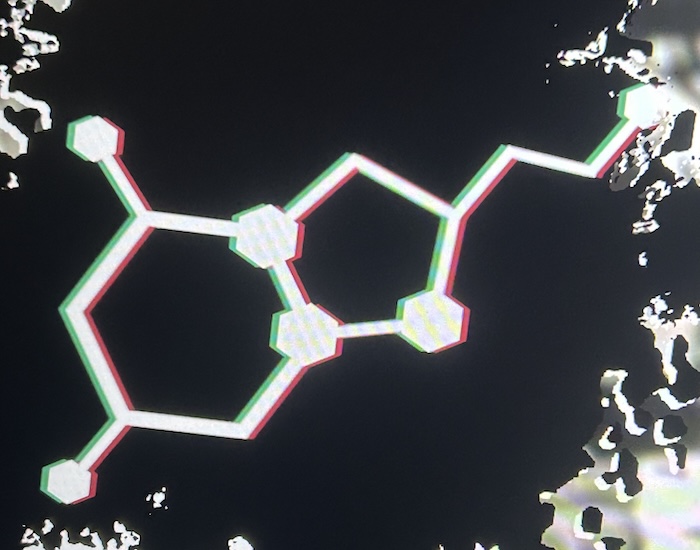
Some future techy in a lab is given a forensics job to do x-ray crystallography before chromatography, somehow separating and purifying the offending chemical before identifying it. I imagine in the future they have machines that can do crystallography automatically for every chemical in the human body, so they did that for the corpse and found a weird chemical that isn’t present normally. To figure out which one it is, laboratories have a ridiculously long list (thousands at the minimum) of all the chemicals in the human body, which has atrophied everyone’s brains so no one knows what neurotransmitters look like anymore so no one can predict that the serotonin analogue works like serotonin. The original designers of the public protein list have passed on, leaving us only with the blind bullshit of instructions without deeper understanding. This is why people know what the chemical looks like but are confused on what it does, whether it’s toxic, and have no ability to test it on animals.
Anyway the ‘we were special friends with him’ thing makes the puzzles a bit weaker because now the super special secret code to his safe that he didn’t want anyone but Morgan to be able to figure out was the date the painting was made. Which she found out by noticing the giant painting on the wall, and then googling the date it was painted. The receptionist would never have been able to figure that one out!
There was a question posed in the first episode on how serial killers could exist in a surveillance state where there are cameras everywhere. The answer in chapter 0 was that the serial killer was a hypercompetent corrupt lawyer who had the knowledge and resources to pull it off. The answer in chapter 1 is that the billionaire didn’t install any in his enormous mansion. I wonder what answer there will be in chapter 2.
At this point in the mystery, the dead guy invited his boss over for drinks, went downstairs into the cameraless vault for a couple of minutes to get a wine bottle, went back upstairs and poured them into two plastic cups, then drank from his cup and died. Everyone is concluding that he poisoned his own cup for some reason.
After that there’s a second 6-letter passcode puzzle, which I was convinced was a number entry puzzle and didn’t think to try letters? But anyway as a testament to their long running friendship full of secret histories only between the two of them, the code is something Morgan learned about about two hours ago. The walkthrough I used says this is “the puzzle that’s the reason I made this guide”.
Also, I take back what I said about the game being gentle, because there is a trial this episode and it is both timed and requires you to actually pick the relevant statement (out 5) and relevant items (out of 3), which is more like Ace Attorney and also wayy too overwhelming. While they’re going on the game doesn’t let you look at the evidence cards again. I used the walkthrough, because:
[Sato: But when a tox screen was run at the hospital, it came back clean.
Morgan: It’s impossible for David Ashur’s tox screen to be clean, and we all know it-
Morgan: Since he was on camera drinking alcohol the night that he died!
AD_84: AHH!!! That makes sense.
Emma: The witness merely misspoke, Your Honor.
Emma: As it plainly states on the tox report itself, Dr. Ashur did have alcohol in his blood-
Emma: But not at such a concentration as to be lethal.]
Yes, that’s why I didn’t pick that option!!!! Morgan herself calls it nitpicky at one point and, to be equally nitpicky back, why would you be held liable for your property when you didn’t even own it at the time of its malfunction?
So as it turns out, preset #19 on the cutting edge no one else heard of it nanomanufacturer machine is the creation of the deadly depressant that will kill you. This was a machine that someone designed, manufactured, and created, but the drugs it outputs are unrecognizable and unknown. So, it could be an insane plot device… or it could be made overseas, I guess? The answer is that it was made by the corporation that keeps all its inventions secret and private, so no one even knew it existed, and in terms of the trial, no one even realized #19 was not actually poisonous on its own, everyone just assumed it was. I actually really like this twist as an example of future dystopia hell where everything is a privatized trade secret, because it’s insane.
The last few puzzles after the actual murderer decided to drink the poison in front of us to show how nonpoisonous it was, I found really easy, but it’s also a whirlwind to get to that point. Except for the part where in the minute of time she had to get away with it, she chugged saltwater and threw up the poison into the sink with the practiced speed of a binge vomiter, which, uh, well, there’s definitely no way I would’ve guessed that on my own. I was thinking she probably had to drink it a bit slower than her victim because he collapsed before she went to call for help, which would’ve also meant that she was starting to respiratory-depress as she forced herself to vomit.
Anyway, so one of the purported reasons as to why she killed him is that the inventor put human brains in a bunch of robots meant for random sale to customers for any sort of slave labor. He released them into the world as property, secretly, to convince people that their property could be more useful. Why didn’t he just use his considerable status and power to just release a line of his children with brains. He could have kept track of where they were going then, and if they needed help.
Of course his favorite creation Serra defends him; she is grateful to them all despite legally being considered property. He made sure to put her barcode right on her hair on purpose, so no one would ever mistake her for a person. Anyway, the love that children exhibit can make you forget all of your sins. Especially if they’re useful children who are worth a lot of money. And her family is out there, so now she has a thing to look forward to. I guess that makes up for putting her in a collar and threatening to dismantle and burn all her parts, because she doesn’t have human rights.
I kind of think the thing with the inventor and the androids that he created as his children and whose work he used and then refused to cite because ~it was too socially unacceptable to do such a thing~ feels like a religious story rather than a people story. He created you and then sent you to random places to live, like how there are a lot of you who have shared elements of youth or culture, but you don’t know each other, as is the thing that happens when seeds are blown in random directions but will be attributed to greater powers. It’s like that stuff about how god is supposed to be your parents, or distant and legendary ancestors, as if you need another story about how great it is to have been someone’s nonconsensual children rather the obvious and existing benefits of your parents having free labor, social capital, and a punching bag. The crime is not murder but patricide. There is no important relationship but creator and progeny, so no matter how many necessary cruelties the creator decides on, no matter how much pain it left you with out of loving stupidity, it’s just so special and important that it’ll be a part of you forever. We tell this incestuous story for identity, comfort, dead frozen pinning of the divine, calm in the form of the blinding hood, to Adonai, Owner and Patriarch, Daddy the Deity. Pater Omnipotens.
This reasoning, of course, is why the miracles of 2088 could only exist as the way they are. If we did not have great men, then where would our androids be? The thing our society is missing is robot slaves. We have people, sure, but they keep dying and quitting and having boundaries and you can’t just treat them like machines, we only know how to deal with machines, because the link between a human and society is the latter manipulating the former and the link between a human and law is the latter extirpating the former, and there is no such thing as nature. There is no other connection left in the world that could do anything for us as much as what we already have. So then the child has more expected from it than the employee, and its valuable and exhaustive service gives the mother the confidence to say that she doesn’t need to spread out its hours to anyone else when her self-produced, self-owned, self-grown, self-made workers are so much smarter and better trained than anyone else inferior. She fears the lawsuit and the public image, but that is neatly sidestepped when she can abuse her property in private.
Like, real depressing!! At least with the prosthetics it’s with adults who can consent or back out or check the documents to see what’s going to be part of their bodies. If you’re some wannabe slaveowner’s kid you’re gonna be saying yes forever, not because you have to, but because you want to.
